
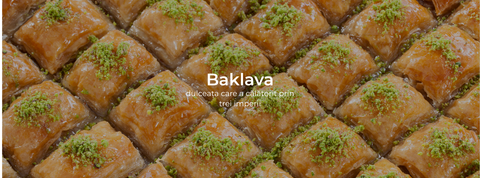
Few desserts have a history as disputed as baklava. Its roots are lost in the kitchens of the Assyrian and Persian Empires, but the recipe we know today – thin layers of dough, filled with walnuts or pistachios, soaked in sugar syrup or honey – was perfected and spread throughout the region by the Ottoman Empire. The palace kitchens in Istanbul prepared baklava for the sultan on special occasions, and from there the recipe traveled to the Balkans, the Levant, and North Africa.
In Turkey, baklava is traditionally made with green pistachios from Gaziantep, extremely thin layers of dough, and a less sweet syrup than in other variations. In Greece, the recipe is similar to the Ottoman one, but walnuts are used instead of pistachios, and the syrup often contains honey and cinnamon, giving it a warmer and more aromatic taste.
In Lebanon and Syria, baklava acquires a distinct note due to the rosewater or orange blossom water added to the syrup, and pistachios remain the star ingredient. The Armenian variant, "paklava," keeps a thicker dough and a mixture of walnuts and cinnamon, while in Iran, "baghlava" is cut into a diamond shape and flavored with cardamom and saffron.
Thus, a simple pastry with layers of dough has become a thread connecting the cuisines of dozens of peoples, each adding its own signature – be it the crunchy pistachios from the Levant or the fragrant honey from Greece.
Comments (0)
There are no comments for this article. Be the first one to leave a message!